Direct Answer
What is mixed-use parking management?
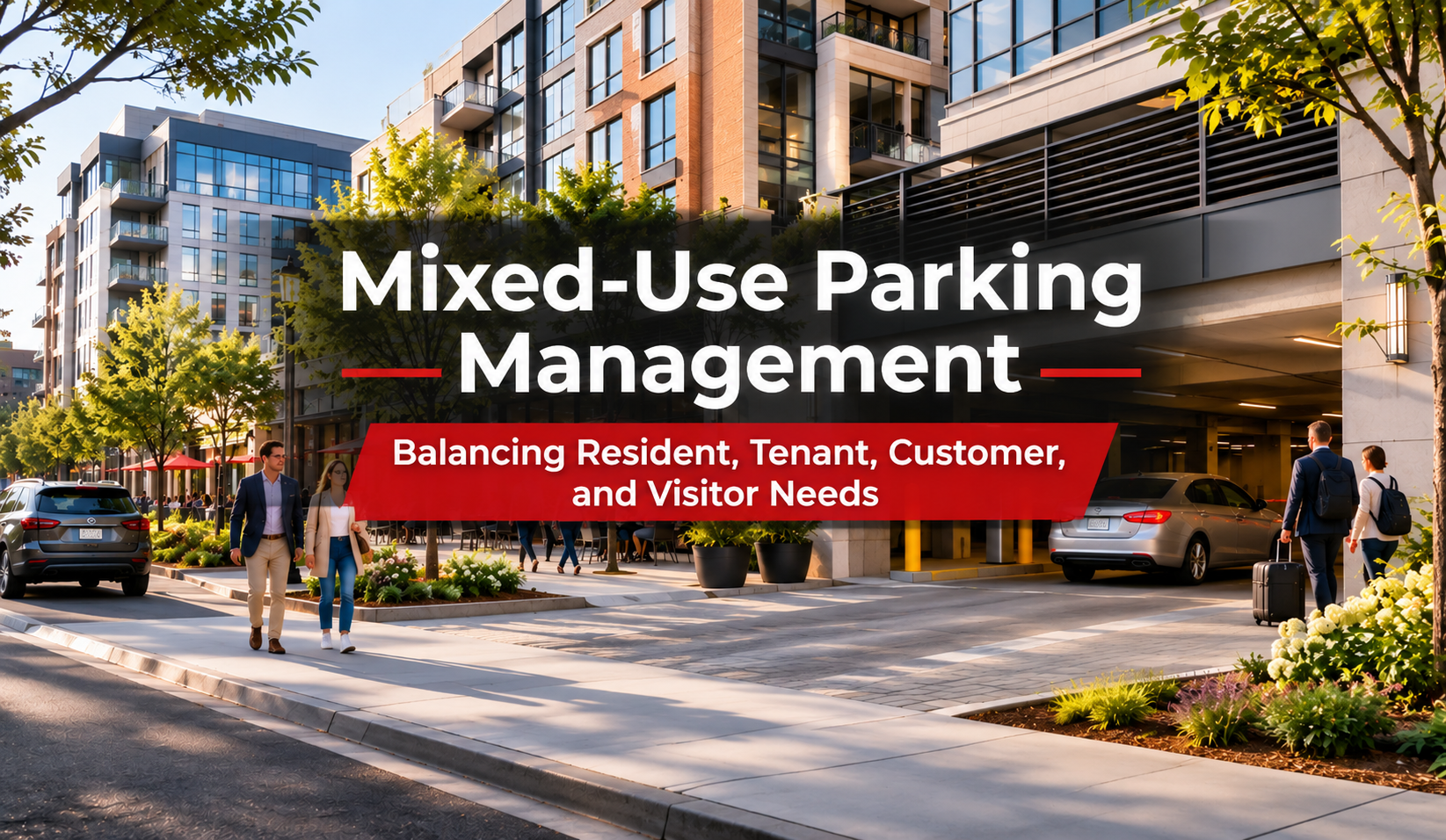
Mixed-use parking management coordinates parking for multiple property uses and user groups within the same development. Because residents, office tenants, employees, retail customers, hotel guests, and visitors often need parking at different times and for different purposes, an effective approach considers the property as a connected parking environment rather than managing each use in isolation.
Key Takeaways
- Mixed-use properties serve user groups with different parking expectations and demand patterns.
- Parking needs can change considerably throughout the day, week, and over time.
- Shared parking may help properties make better use of existing capacity when user needs complement one another.
- Access, technology, signage, and parking policies should support a clear experience across the development.
- Effective parking management should support the broader goals of the property, including convenient access and operational performance.
Why Mixed-Use Properties Require a Different Parking Approach
Mixed-use developments may bring together residential apartments, offices, retail stores, restaurants, hotels, entertainment venues, and other uses within one property or district.
That creates a parking environment with competing needs.
Residents may need dependable overnight access. Office tenants and employees may generate their greatest demand during weekday business hours. Retail and restaurant customers often rely on convenient short-term parking, particularly during evenings and weekends. Hotel guests, visitors, deliveries, and events can introduce additional demand throughout the day.
A parking approach designed primarily around one group can create challenges for another. Long-stay vehicles may limit convenient customer parking, for example, while overly restrictive parking policies may create frustration for residents or visitors.
Mixed-use parking management considers how these different needs interact so the parking operation can better support the development as a whole.
Common Mixed-Use Parking Challenges
Resident and Visitor Parking
Residents generally expect reliable access to parking close to where they live, while their guests need a clear and convenient way to park without creating unnecessary conflicts.
The appropriate balance will vary depending on the property's capacity, residential agreements, visitor activity, and other uses within the development.
Clear access policies and communication can help residents and visitors understand where and how they should park.
Office Tenants, Employees, and Business Visitors
Office environments often create concentrated parking demand during weekday hours.
Employees, tenants, clients, and visitors may all rely on the same parking facilities, while workplace patterns can change over time. A parking program therefore needs to account for both regular users and more variable visitor demand.
Retail and Restaurant Customers
For retail and dining businesses, convenient parking can be an important part of the customer experience.
Their busiest periods may differ significantly from office or residential demand. Evening dining, weekend activity, holidays, and special events can all affect how parking is used.
Parking policies should support customer access without unnecessarily disrupting the needs of other users.
Hotels, Entertainment, and Events
Hospitality and entertainment uses can introduce another layer of variability.
Guest arrivals and departures, events, seasonal activity, and weekend traffic may create temporary peaks that differ from normal daily conditions.
Parking operations that can accommodate these changes help support a more consistent experience across the property.
Understanding Changing Parking Demand
One of the defining characteristics of mixed-use parking is that demand changes.
An office component may be busiest during the workday, while restaurants and entertainment venues may create more activity later in the day. Residential demand may increase overnight.
These differences can sometimes create opportunities to make more effective use of available parking, particularly when user groups need spaces at complementary times.
Understanding those patterns is an important part of developing a parking approach that fits the property.
How Shared Parking Can Support Mixed-Use Developments
Shared parking allows parking inventory to serve more than one user group when their needs occur at different times.
For example, parking that primarily supports office activity during the day may have additional capacity available when evening restaurant demand increases.
This does not mean shared parking is appropriate for every property. Lease requirements, access arrangements, available capacity, accessibility, and other property-specific considerations all affect what is feasible.
When appropriate, however, shared parking can help a development make better use of its existing parking resources.
The Role of Parking Technology
Technology can support mixed-use parking by helping different users access and navigate the parking environment more easily.
Depending on the property, parking technology may support areas such as:
- Access and credential management
- Digital permits
- Parking reservations
- Payment
- Retail or restaurant validation
- Occupancy visibility
- Reporting
- Signage and wayfinding
The most effective technology is not necessarily the most complex. It should address a clear operational need and create a straightforward experience for the people using the facility.
Because mixed-use properties often include different users, systems, and operating requirements, technology should fit the property rather than forcing every environment into the same model.
Why Access, Signage, and Wayfinding Matter
A mixed-use property can quickly become confusing when drivers encounter different entrances, parking areas, restrictions, payment processes, or access requirements.
Residents, tenants, customers, and visitors should be able to understand where they need to go and what is expected of them.
Clear signage, accurate parking information, visible instructions, and logical traffic flow can help reduce unnecessary circulation and make the overall experience easier to navigate.
These details are particularly important in developments where the same parking facility serves people who may have very different levels of familiarity with the property.
Supporting Property Performance
Parking is only one part of a mixed-use development, but it can affect how people access and experience the property.
A well-managed parking operation can help property teams better understand how parking is being used, identify changing needs, and make informed decisions as the development evolves.
Financial performance is one consideration, but it should be viewed in the context of the property as a whole.
For example, a parking decision that produces additional revenue but makes it unnecessarily difficult for customers to reach retail or dining businesses may work against broader property objectives.
The goal is to support an appropriate balance among parking access, utilization, customer experience, and property performance.
What Matters in a Mixed-Use Parking Management Provider?
Mixed-use environments require an understanding of how different property uses interact.
When evaluating parking management support, property owners and managers should look for experience with complex environments and an ability to adapt operations to the specific property rather than applying one model everywhere.
Relevant considerations may include:
- Experience serving multiple user groups
- Understanding of changing parking demand
- Appropriate technology capabilities
- Clear communication and reporting
- Focus on tenant, resident, customer, and visitor experience
- Ability to adjust as property needs evolve
The right approach should support the property's larger operating goals while recognizing that residential, commercial, hospitality, and visitor needs may not always align.
Adapting as the Property Changes
Mixed-use developments are rarely static.
Tenant turnover, residential occupancy, new restaurants or retailers, changes in operating hours, and special events can all influence parking demand.
That makes ongoing visibility into parking performance important. Rather than treating the original parking plan as permanent, property teams should be able to identify when conditions have changed and determine whether the operation still supports the needs of the development.
Frequently Asked Questions About Mixed-Use Parking Management
What is the best parking management approach for a mixed-use property?
There is no single model that fits every mixed-use development. The right approach depends on factors such as the property's uses, parking capacity, user groups, operating requirements, and demand patterns. Parking management should support the specific needs of the development rather than applying the same policies to every user.
How can mixed-use properties balance resident and retail parking?
Mixed-use properties can use clearly defined parking areas, access policies, visitor options, validation programs, and shared parking where appropriate. The goal is to protect reliable access for residents while maintaining convenient parking for customers and visitors.
Can shared parking improve parking utilization?
Shared parking can help properties make better use of available capacity when different user groups need parking at different times. Whether it is appropriate depends on the property's demand patterns, available capacity, agreements, access requirements, and other site-specific considerations.
How can technology support mixed-use parking management?
Technology can support access, permits, reservations, payments, validation, parking visibility, and reporting. The most appropriate solutions depend on the property and should address specific needs without making parking unnecessarily complicated for users.
When should a mixed-use property consider outsourcing parking management?
Outsourcing may be worth evaluating when parking operations involve multiple user groups, competing access needs, changing demand, or a level of operational oversight that is difficult to manage internally. Property owners should consider their goals, resources, responsibilities, and service requirements when determining the appropriate operating model.
Building a Better Mixed-Use Parking Experience
Mixed-use parking management requires an understanding of how residents, office tenants, employees, retail customers, guests, and visitors interact with the same parking environment.
By accounting for changing demand, access needs, shared parking opportunities, technology, and the overall user experience, property teams can develop parking operations that better support the broader goals of the development.
Propark works with complex parking environments to develop solutions around the needs of each property and the people who use it. For mixed-use developments balancing multiple parking demands, the right approach starts with understanding the property itself.