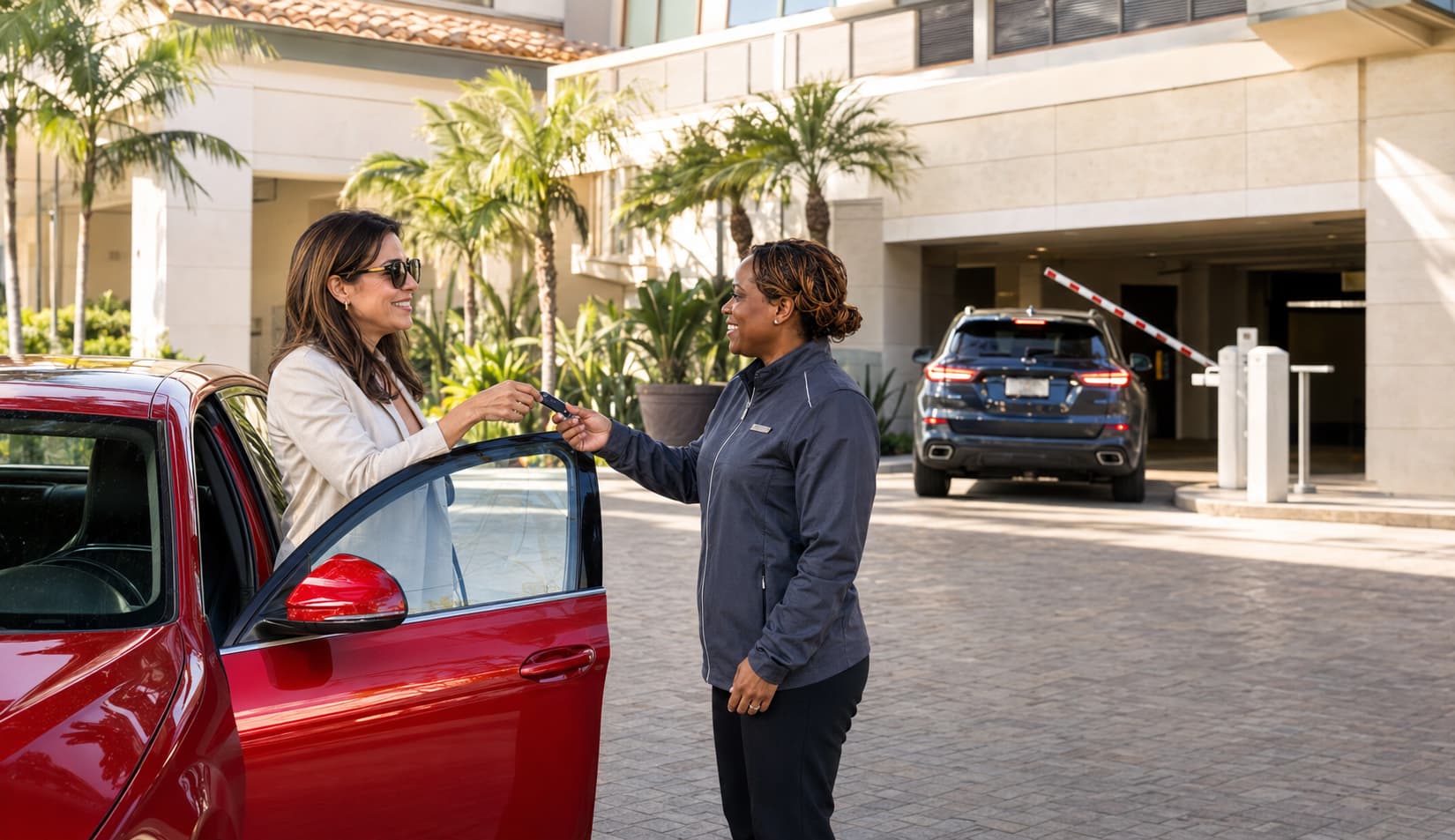
Direct Answer
What is the difference between valet parking and self-parking?
With valet parking, a trained employee accepts, parks, and retrieves your vehicle. With self-parking, you enter the facility, choose an eligible space, park the vehicle yourself, and return to it when leaving. The better option depends on the destination, walking distance, available time, accessibility needs, familiarity with the facility, and personal preference.
Introduction
Airports, hotels, hospitals, restaurants, offices, and event venues may offer more than one way to park.
Two of the most common options are valet parking and self-parking.
With valet parking, you leave your vehicle with a trained employee at a designated arrival area. With self-parking, you enter the garage or lot and park the vehicle yourself.
Neither option is universally better.
Valet may be helpful when you want a more direct arrival, prefer not to search for a space, are managing luggage, or want to reduce the distance between vehicle drop-off and the entrance. Self-parking may be a better fit when you prefer to park and retain your own vehicle, know the facility well, or want direct control over where you park within the permitted area.
Price, availability, walking distance, service hours, payment procedures, vehicle handling, and retrieval or exit instructions vary by location.
This guide explains how valet and self-parking work, compares the main differences, and helps you identify which option may fit a particular trip or destination.
What Is Valet Parking?
Valet parking is a service in which a trained parking employee accepts, parks, and retrieves a customer's vehicle.
Instead of entering the parking area and searching for a space, the driver generally arrives at a designated valet zone near an entrance or arrival point.
Valet parking may be available at:
- Hotels and resorts
- Hospitals and medical facilities
- Airports and near-airport parking locations
- Restaurants
- Event venues
- Office buildings
- Residential properties
- Mixed-use developments
The exact service and procedure vary by property.
A valet program may use:
- A staffed arrival area
- Vehicle and key-control procedures
- A physical or digital claim method
- Valet-management technology
- Text or mobile retrieval requests
- Designated vehicle-storage areas
- Location-specific payment procedures
Drivers should follow the signs and instructions provided at the individual location.
How Valet Parking Works
1Arrive at the Designated Valet Area
Follow signs to the correct valet entrance or drop-off zone.
At properties with several entrances, confirm which valet area serves your destination.
2Prepare for Vehicle Drop-Off
Before handing over the vehicle:
- Gather the items you need
- Keep important personal belongings with you
- Communicate any vehicle features or instructions the valet team should know
- Follow location-specific instructions about keys or vehicle operation
3Check In With the Valet Team
A valet employee accepts the vehicle and provides the information needed for retrieval.
Depending on the location, that may include:
- A claim ticket
- A text message
- A digital confirmation
- A QR code
- A retrieval number
- Instructions for requesting the vehicle
Keep the claim information available until the vehicle is returned.
4The Vehicle Is Parked
The valet team moves the vehicle to the parking area used for that operation.
The storage location, parking format, and procedures depend on the property.
5Request and Receive the Vehicle
When preparing to leave, follow the retrieval instructions.
A location may ask you to:
- Present a claim ticket
- Send a text message
- Use a mobile link
- Scan a code
- Speak with the valet team
- Request the vehicle through the property
Return to the designated pickup area and confirm that you have the correct vehicle, keys, personal items, and any receipt or payment confirmation you need.
Retrieval procedures and timing vary by location and demand.
What Is Self-Parking?
Self-parking allows drivers to enter a parking garage or lot and park their own vehicles.
The driver generally:
- Enters through the appropriate lane or access point
- Follows the facility's signs
- Locates an eligible space
- Parks and secures the vehicle
- Walks or uses available transportation to reach the destination
- Returns to the vehicle when leaving
Self-parking is available across many property types, including airports, hospitals, offices, hotels, universities, residential communities, shopping destinations, and event locations.
Drivers select their own eligible space, subject to availability, permits, reservation terms, posted signs, and facility rules.
How Self-Parking Works
1Enter the Facility
Entry may involve:
- Taking a ticket
- Scanning a reservation
- Using a monthly credential
- License plate recognition
- An access card
- A mobile or contactless process
- Paying upon entry
Follow the instructions for the individual location.
2Find an Eligible Space
Avoid areas designated for:
- Reserved or assigned customers
- Valet operations
- Accessible parking without the required authorization
- EV charging when not using the charger
- Employees, tenants, residents, or permit holders
- Oversized or restricted vehicles
3Park and Save the Location
Park within the marked space and follow the facility's rules.
Before leaving, note the:
- Garage level
- Row or section
- Space number
- Nearest elevator or stairwell
- Pedestrian entrance
- Lot name
- Shuttle stop, when applicable
A photo of a nearby sign may help you find the vehicle later.
4Return and Exit
When returning:
- Follow signs back to the parking area
- Locate the vehicle
- Complete payment or validation when required
- Use the correct credential or exit lane
Entry and exit procedures may differ.
Valet Parking vs. Self-Parking at a Glance
| Consideration | Valet Parking | Self-Parking |
|---|---|---|
| Who parks the vehicle? | A trained valet employee | The driver |
| Who keeps the key? | The valet operation generally retains the key until retrieval | The driver generally keeps the key |
| Searching for a space | The driver does not normally search for a space | The driver locates an eligible space |
| Arrival point | A designated valet drop-off area | An available space within the garage or lot |
| Walking distance | Drop-off is often near a designated entrance; the remaining walking distance varies by property | Depends on the selected space, facility layout, and destination |
| Vehicle retrieval | The driver requests the vehicle from the valet team | The driver returns to the parked vehicle |
| Driver control | The valet team parks and retrieves the vehicle | The driver manages the parking process directly |
| Price and payment | Rates, fees, validation, and payment procedures vary by location and service | Rates, fees, validation, and payment procedures vary by facility and parking option |
| Technology | May include digital check-in, claim, payment, or retrieval tools | May include reservations, mobile payment, LPR, credentials, or parking guidance |
| May fit drivers who prioritize | A designated arrival point, reduced searching, or a shorter route from drop-off | Parking the vehicle personally, familiarity, or direct control over space selection |
Neither option is automatically faster, more convenient, or more appropriate in every situation. The experience depends on the facility, traffic, demand, staffing, layout, operating procedures, and driver preference.
When Valet Parking May Be a Good Fit
When the Facility Is Large or Unfamiliar
Valet removes the need for the driver to enter the parking area and search for an eligible space.
This may be useful at large healthcare campuses, hotels, airports, events, and unfamiliar urban properties.
When the Arrival Point Matters
Valet may be helpful when its drop-off area is closer to the destination than available self-parking.
The actual walking distance and route vary by property.
When Managing Luggage or a Group
Drivers traveling with luggage, children, several passengers, or multiple personal items may prefer to unload at the valet area before the vehicle is parked.
The assistance available depends on the service and location.
May Support Some Mobility-Related Needs
A valet arrival point may reduce the distance a driver or passenger needs to travel from the vehicle to an entrance.
Drivers should still review the property's accessibility information and contact the location when specific assistance is needed.
When Visiting a Hospital or Hotel
Hospital valet may offer patients and visitors a more direct arrival option. Hotel valet may allow guests to unload luggage near the entrance.
Procedures, hours, accessibility information, and available assistance vary by property.
When Using Airport or Event Valet
Airport and event valet services may provide designated arrival areas, but drivers should confirm:
- Facility location
- Terminal or venue transportation
- Arrival timing
- Vehicle check-in
- Retrieval instructions
- Procedures for delayed returns
When Self-Parking May Be a Good Fit
When You Prefer to Park the Vehicle Yourself
Self-parking allows the driver to choose an eligible space and retain the keys.
When You Know the Facility
Drivers who regularly use the same garage or lot may already understand its entrances, parking areas, pedestrian routes, payment methods, and exit procedures.
When You Want Direct Access to the Vehicle
At some destinations, a driver may need to return to the vehicle during the visit.
Whether repeated vehicle access or reentry is permitted depends on the facility and parking arrangement.
When the Walking Route Fits the Trip
Self-parking may be practical when:
- The facility is easy to navigate
- The walking route is manageable
- Parking guidance is available
- The destination is familiar
- The driver prefers a self-service process
When Using Monthly or Recurring Parking
Monthly customers frequently use self-parking with a permit, card, digital credential, or registered license plate.
For more information, read Monthly Parking Explained.
What to Review Before Choosing
Availability and Service Hours
Not every location offers both options. Confirm whether the property provides:
- Valet only
- Self-parking only
- Both options
- Valet during limited hours
- Event-specific valet
- Reservation-only service
A parking facility may remain open outside the hours when valet service is available.
Price and Payment
Review:
- Parking rate
- Valet or self-parking option selected
- Taxes and fees
- Validation
- Payment timing
- Accepted payment methods
- Reservation requirements
- Charges related to extended parking or delayed retrieval, when applicable
Rates and payment procedures vary by property. Valet is not always more expensive, and self-parking is not always the lower-priced option.
Arrival Instructions
Confirm the correct:
- Entrance
- Valet drop-off area
- Self-parking lane
- Reservation process
- Access credential
- Signs and directions
Walking Distance and Route
For self-parking, consider:
- Distance to the destination
- Elevators or stairs
- Pedestrian entrances
- Shuttle service
- Luggage
- Weather exposure
- Mobility needs
For valet, confirm where vehicle drop-off and pickup occur.
Vehicle and Key Procedures
For valet, review instructions about:
- Keys
- Vehicle features
- Claim process
- Retrieval
- Oversized vehicles
- Personal belongings
For self-parking, review:
- Height limits
- Space restrictions
- Permits
- Vehicle-registration requirements
- Reservation rules
Retrieval or Exit Process
Valet retrieval may involve presenting a ticket, sending a text, using a mobile link or code, or requesting the vehicle from a valet employee.
Self-parking exit may involve payment, validation, a registered plate, or another credential.
Accessibility Information
Valet may reduce the distance from vehicle drop-off to an entrance, while self-parking may provide designated accessible spaces and routes.
The better option depends on the facility and the individual's needs.
Parking Technology
Valet systems may support:
- Digital check-in
- Claim information
- Retrieval requests
- Payment
Self-parking systems may support:
- Reservations
- License plate recognition
- Parking guidance
- Mobile payment
- Contactless access
For more information, read Parking Technology That Helps Drivers.
Valet and Self-Parking at Different Destinations
Hotels
Valet may provide a designated arrival point for unloading luggage. Self-parking may appeal to guests who prefer to park and retrieve the vehicle themselves.
Hospitals
Valet may support patients or visitors seeking a more direct arrival. Self-parking may work well for physicians, staff, frequent visitors, and people familiar with the campus.
Airports
Airport valet may reduce the need to search for a space, while self-parking allows travelers to select their own eligible space and retain their keys. Either option may involve a walk, shuttle, or another transfer process.
Restaurants and Events
Valet and self-parking may use different entrances, arrival windows, payment procedures, and exit routes. Review the destination-specific instructions before arriving.
Offices and Mixed-Use Properties
Visitors may encounter valet at hotels, restaurants, residences, meetings, or events within the property. Employees, tenants, and residents may rely more heavily on self-parking credentials or monthly access.
Common Misconceptions About Valet and Self-Parking
“Valet parking is only available at luxury hotels.”
Valet is also used at hospitals, airports, restaurants, events, offices, residential properties, and mixed-use developments.
“Valet is always faster.”
Arrival and retrieval times depend on traffic, demand, staffing, facility layout, and operating procedures.
“Self-parking always requires a long walk.”
Walking distance depends on the parking space, facility layout, destination, and available transportation.
“Self-parking is always faster.”
A driver may still need to navigate the facility, find a space, walk to the destination, and complete payment or access procedures.
“Valet is automatically safer than self-parking.”
Safety depends on the facility, its procedures, and current conditions. Neither parking format carries a universal safety guarantee.
“Self-parking does not use modern technology.”
Many self-parking facilities use reservations, mobile payments, license plate recognition, digital credentials, and parking-guidance systems.
“One option is always better.”
The better option depends on the destination, available services, walking distance, accessibility needs, timing, and personal preference.
Frequently Asked Questions
What is the difference between valet parking and self-parking?
With valet parking, a trained employee accepts, parks, and retrieves your vehicle. With self-parking, you enter the facility, select an eligible space, park the vehicle yourself, and return to it when leaving.
How does valet parking work?
You generally drive to a designated valet area, give the vehicle and keys to a trained employee, receive claim or retrieval information, and request the vehicle when you are ready to leave. Procedures vary by location.
When should I choose valet parking?
Valet may be a good fit when you prefer a designated arrival point, do not want to search for a space, are carrying luggage, want to reduce walking distance, or are visiting an unfamiliar property.
When should I choose self-parking?
Self-parking may be a good fit when you prefer to park the vehicle yourself, retain your keys, know the facility, or want direct control over choosing an eligible space.
Is valet parking safe?
Valet parking typically uses defined vehicle intake, key-control, parking, and retrieval procedures, but conditions vary by location and no parking format carries a universal safety guarantee. Follow the provider's instructions, keep important belongings with you, and contact the location with specific questions.
Does valet parking reduce walking distance?
Valet drop-off is often located near a property entrance or designated arrival point, which may reduce walking. The actual distance and route depend on the location.
Does self-parking use parking technology?
Many self-parking facilities use reservations, mobile payment, license plate recognition, digital access credentials, contactless entry and exit, or parking guidance. Available technology varies.
Can I reserve valet or self-parking in advance?
Some locations allow advance reservations for valet, self-parking, or both. Review the facility's availability, reservation terms, and arrival instructions.
Which option is better for airport parking?
The better choice depends on the facility, terminal-transfer process, luggage, walking distance, available time, and whether you prefer valet or parking the vehicle yourself.
Which parking option is best?
There is no universal answer. Compare the destination, price, arrival process, walking route, service hours, accessibility information, vehicle procedures, and personal preference.
Final Thoughts
Valet parking and self-parking provide different ways to begin and end a visit.
Valet allows a trained employee to park and retrieve the vehicle, which may help drivers avoid searching for a space and provide a more direct arrival point.
Self-parking allows drivers to park their own vehicles, retain their keys, and manage the parking process directly.
The better option depends on the individual location and trip. Before choosing, review:
- Availability
- Price and payment
- Operating hours
- Arrival instructions
- Walking distance
- Accessibility information
- Vehicle and key procedures
- Technology
- Retrieval or exit process
Find a Propark parking location and review the valet and self-parking options available for your destination.